
Throwing sand in the gears of offshore scammers
A knock comes at the door. The occupant opens it to find a police officer and an investigator from the BC Securities Commission (BCSC).
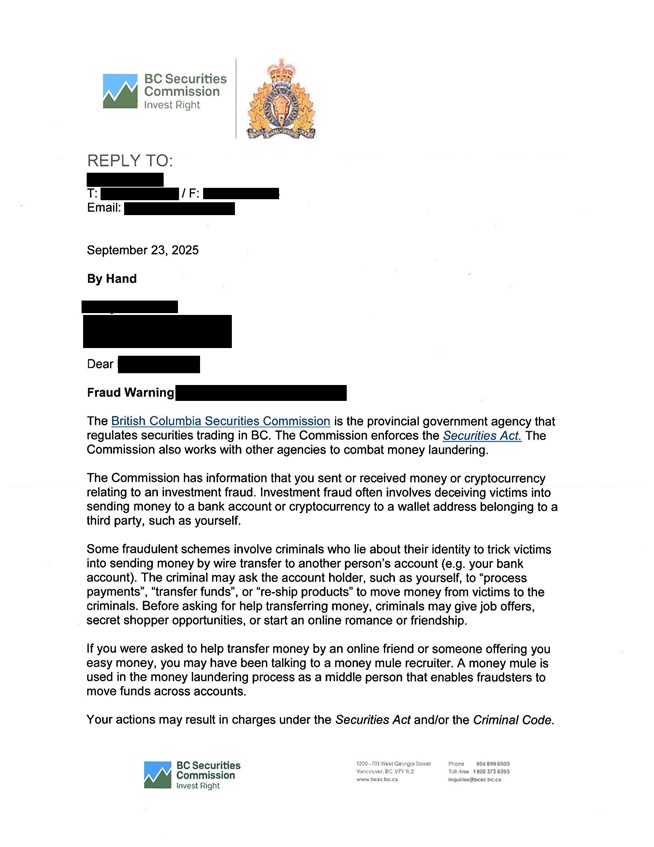
They would like to talk about money laundering – specifically, to warn the person answering the door, or someone living at that address, that they are suspected of transferring funds for investment fraud.
"The Commission has information that you sent or received money or cryptocurrency relating to an investment fraud,” says the warning letter they deliver. “Investment fraud often involves deceiving victims into sending money to a bank account or cryptocurrency to a wallet address belonging to a third party, such as yourself.”
That scene has played out dozens of times since May 2024, when the BCSC and the RCMP fanned out across the Lower Mainland to deliver letters to so-called “money mules.”
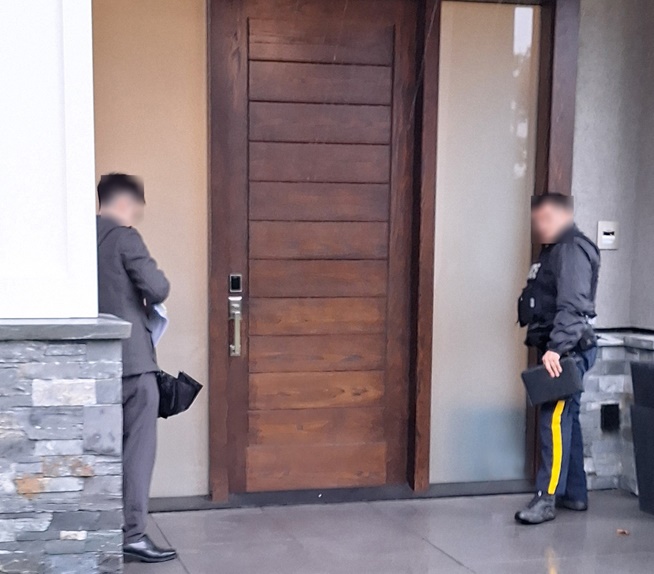
A BCSC investigator and an RCMP officer trying to deliver a warning letter to a suspected money mule. |
The rise of “pig butchering”
Money mules started to occupy a greater share of the BCSC’s attention a few years ago, as the COVID-19 pandemic changed the shape of investment fraud.
With so many people stuck at home, fraudsters ramped up their use of online channels to entice people into fraudulent investment schemes. They cultivated online relationships with victims over weeks or months, then gradually mentioned an investment opportunity, and ultimately convinced victims – often with the help of fake websites and other online collaborators – to send money by bank wire or through crypto blockchains, in the expectation of getting substantial returns. Their modus operandi is often called “pig butchering,” because they often allow victims to withdraw fake profits as an enticement to sending larger amounts, akin to fattening up a pig before slaughtering it.
And the perpetrators are not lone operators. They are part of large operations orchestrated by organized crime groups, particularly in southeast Asia.
The BCSC’s traditional tools for fighting investment fraud – investigating and bringing cases to a hearing before a panel of BCSC commissioners – are ineffective with organized crime groups operating in other countries. The same is true for police and prosecutors – search warrants, arrests, trials, and sentencing are no match for cabals operating in faraway countries, often in isolated locations.
So the BCSC pivoted to disrupting these scammers by throwing sand into the gears of their operations.
This is how money mules entered the picture.
Fertile ground for money transfers
The scammers need to move the victims’ funds through accounts that aren’t on law enforcement’s radar, and ideally, whose owners aren’t, either. So they enlist others to open accounts, or use their existing accounts, as way-stations for the funds on their way to the ultimate destination.
It just so happens that B.C., especially the Lower Mainland, is an immigrant-rich region, where sending or receiving money internationally is commonplace, and where there are many non-bank businesses that provide such services.
Many of those businesses are part of the hawala ecosystem – a network of brokers scattered throughout the world who operate on a basis of shared trust. Their footprint in the Lower Mainland has fostered a cultural acceptance of informal money transfers, which has probably made it easier to find and recruit money mules.
Following the money
Around that time, Sammy Wu, head of the BCSC’s Detection, Assessment and Disruption Unit, attended an international conference on fraud and heard an official from the U.S. Postal Inspection Service describe how his agency had delivered warning letters to people who were receiving cash through the mail. On the suspicion that the recipients were money mules, the letters explained that doing so was illegal.
As law enforcement agencies in Canada, the U.S., and elsewhere began sharing their insights about money mules with each other, Wu thought the warning letter tactic held promise, especially given the difficulty of using the BCSC’s traditional enforcement tools – investigation and litigation – against offshore scammers.
The BCSC compiled a list of local people who received funds from pig butchering victims. Some names were provided by the victims, because they wired money to them. Other individuals were identified by the BCSC through blockchain tracing – following the movement of a victim’s crypto from one wallet to another, and then determining who owned the receiving wallet.
|
|

“Now you know”
Although warning letters might be seen as tipping off criminals, many money mules don’t fit the stereotypical profile of law-breakers. Some have criminal records or known ties to organized crime, but others have strong suspicions that they’re engaged in something shady and would prefer not to know more. And some are victims themselves – they were ensnared by investment scammers, sent money to them, and think the money they’re receiving is actually the “return on their investment.” So, for some of these mules, a warning could be effective in getting them to stop.
Delivering the letters also serves a legal strategy. Facilitating the movement of funds derived from investment fraud could be considered “aiding and abetting” under B.C.’s Securities Act. To give such an allegation a better chance of success, the BCSC wants proof that the person knowingly did so. The letters, once delivered, give the BCSC a possible basis for establishing that any future money transfers in the service of investment fraud were done knowingly by that person.
“If you didn’t know before, well, now you know,” Wu says.
|
Partnering up
Another reason for the tactic, Wu says: “When they start talking, you get a sense of how they got involved.”
The BCSC partnered with the RCMP for these “knock and talks,” because they share the BCSC’s desire for a better line-of-sight into money laundering, and because it doesn’t hurt to have uniformed police on hand when making unannounced visits.
The first round of letters was delivered to 10 people throughout the Lower Mainland in May 2024. Four more rounds followed, for a total of 36 warnings so far.
Closure? Not so much
Has it made a difference? Wu says it’s difficult to say, as is the case with most disruptive tactics.
“We don’t know if a particular person stopped being a money mule because of the letter, or would’ve stopped without our intervention,” Wu says.
|
|

If the recipient of a warning letter surfaces in another investigation, the BCSC or police could gather additional evidence to support formal allegations of investment market misconduct, criminal charges, or both.
But if the effort does nothing more than create friction for the scammers, Wu is convinced it’s worthwhile.
“The more energy the scammers spend on recruiting replacement money mules or trying to evade investigators’ attention, the less energy they have to focus on scamming people,” he says.